

Mali and Syria: Similarities, Differences, and the War on Terror
The contrasts between Syria and Mali underscore the latest permutations of the long-running, ambiguous “War on Terror.”

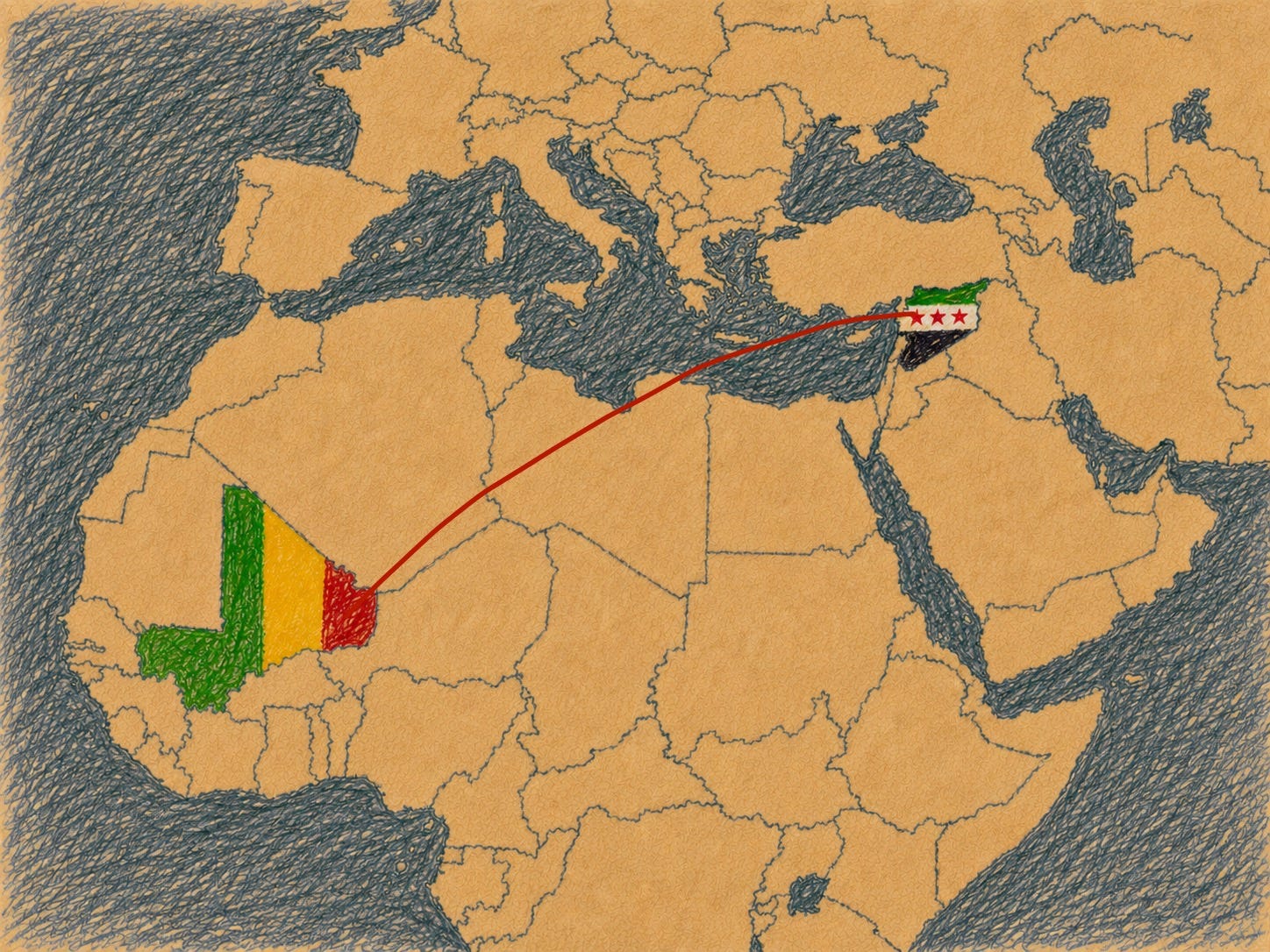
For Syria’s Ahmad al-Sharaa and Mali’s Iyad ag Ghali, 2017 was a pivotal year. As skilled strategists and remarkable survivors, both men took leadership of new coalitions which led to profound change in the civil wars plaguing their respective countries. Al-Sharaa’s Hay’at Tahrir al-Sham (HTS, or literally “Syria Liberation Organization”), freshly decoupled from al-Qaeda, embarked on a “mainstreamization” effort by shedding its most radical commitments and embracing pragmatism and technocracy. It was this coalition that eventually toppled longtime Syrian President Bashar al-Assad in December 2024. Today, al-Sharaa is Syria’s head of state.
Similar to al-Sharaa, in 2017 Ag Ghali supervised the formation of a coalition called Jama‘at Nusrat al-Islam wa-l-Muslimin (JNIM, or literally “the Group for Supporting Islam and Muslims”) which focused its energies on attacking Malian and Burkinabè security forces, contesting the presence of French troops in the Sahel, and participating in brutal intercommunal wars. On April 25 of this year, JNIM unleashed an astonishing series of attacks across more than 1,500 kilometers of Malian territory, from the capital Bamako in the south to the storied town of Kidal deep in the Sahara. The attacks underscored the ruling junta’s weakness, killed the defense minister, and returned Kidal—whose 2023 conquest was the Malian military’s greatest accomplishment in recent years—to rebel hands.
Analysts and journalists have accordingly debated whether JNIM will soon follow the “Syria model.” Yet the discussion is strikingly narrow. What, after all, is the “Syria model”? Much of the recent debate has focused on whether JNIM would break with al-Qaeda, reduce its attacks on civilians, and seek to rule Mali in a way that neighboring states and Western powers might tolerate. While these features certainly defined HTS leading up to its overthrow of Assad, the “Syria model” is not just about ideological deradicalization; it is also about neoliberalism and the containment of revolution.
HTS: Coalition-Building, Technocracy, and Pragmatism
Al-Sharaa’s personal arc is fairly well established: the son of a doctorate-holding economist who worked for the petroleum ministries of Syria and Saudi Arabia, he fought in Iraq as part of the loose al-Qaeda affiliate there in the 2000s and led the expeditionary jihadist force Jabhat al-Nusra (“Support Front”) in Syria amid the early stages of the revolution. When Abu Bakr al-Baghdadi and Ayman al-Zawahiri clashed over control of the insurgency in Iraq and Syria, al-Sharaa sided with al-Zawahiri and al-Qaeda against what became the Islamic State (ISIS). Eclipsed by ISIS in infamy and brutality, Jabhat al-Nusra nevertheless committed numerous war crimes in the early 2010s, including executions of civilians.
In 2015, Jabhat al-Nusra participated in capturing Idlib, a provincial capital in northwest Syria. In 2016, in a display of pragmatism meant to attract partners among Syria’s armed groups, Jabhat al-Nusra became Jabhat Fath al-Sham (“Syria Conquest Front”) and dropped all external affiliations, including any formal ties to al-Qaeda. In early 2017, the group renamed itself once again, to Hay’at Tahrir al-Sham, and announced the formation of its “Salvation Government” later that year.
The Salvation Government had a self-consciously technocratic character. Senior officials, including both HTS members and non-members, often had university degrees, technical expertise, and a polished approach toward journalists, foreign researchers, and diplomats. These senior technocrats included figures such as Mohammed al-Bashir and Asaad al-Shaibani, who went on to serve in ministerial posts (currently, Energy and Foreign Affairs) after HTS’ overthrow of Bashar al-Assad.
HTS’ technocratic posture in Idlib foreshadowed some of the pragmatic choices that al-Sharaa would make as Syria’s transitional head of state. Technocracy, despite its promises of rule by and through apolitical expertise, often has a markedly neoliberal character. While al-Sharaa reshaped Syria’s political topography, he remains in many ways a conventional head of state: conciliatory toward Israel, the United States, the European Union, and the Gulf; friendly with Assad-era businessmen; courting foreign investors to finance and profit from reconstruction; and committed to slashing the public sector while privatizing state-owned enterprises.
As Riad Alarian and Mohammed El-Sayed Bushra wrote for Muftah last year, al-Sharaa faced tremendous pressure to make “a statement of allegiance to the free market” as one of many “incentivized rituals of compliance pursued in exchange for access to the material conditions that permit state-building.” Richard Solomon has similarly argued for Phenomenal World that there is substantial continuity with the era of Bashar al-Assad, who spent a quarter-century privatizing firms, cutting pensions, and empowering cronies. The fall of the Assad dynasty gave hope to millions of Syrians and altered many lives for the better, allowing people to return home, reunite with family and friends, and pursue long-deferred dreams and goals. Yet the new authorities offer a stability predicated on deference to the geopolitical status quo.
JNIM: Rejecting Foreign Intervention, Dominating Civilians, and Hammering Bamako
JNIM has constituted the central military and political challenge for both the civilian President Ibrahim Boubacar Keïta (who was in office from 2013 until 2020) and the military rulers, headed by Colonel-turned-President Assimi Goïta (who took power in a 2020 coup). JNIM and its antecedents have outlasted French counterterrorism operations (2013–2022) and pro-government deployments by the Kremlin-backed Wagner Group/Africa Corps (2021–present), all while JNIM veers between coexistence and conflict with the regional “province” of the Islamic State. JNIM is nothing if not tenacious.
JNIM has pursued a multi-faceted and even ambiguous project. On the one hand, JNIM exhibits a clear will to power. In central Mali and northern Burkina Faso—two sites of intensive jihadist operations—JNIM’s approach to rule has manifested clearly: the group’s field commanders impose “survival pacts” on local communities, dictating what can be taught in schools, what women can wear, who can carry weapons, and how economies will operate. Communities that resist can face economic blockades, one of JNIM’s favored weapons of war.
On the other hand, JNIM has appeared reluctant to bid for full control of Mali. JNIM can certainly capture major towns, and has done so temporarily on various occasions. But they have not planted their flag in any administrative capital, let alone a national capital. Is that because JNIM still heeds the lessons of 2012–2013, when some of its forerunners seized northern Malian towns and declared an Islamic Emirate, only to see French troops smash their positions and kill various top leaders just a few months later? Is it because JNIM’s fighting strength is enough to haunt a zone extending over 2,000 kilometers, but does not suffice to wield durable control? Or is it rather because JNIM does not want the responsibilities and liabilities that direct rule would bring? According to one frequently cited but perhaps unreliable estimate, JNIM may have as few as 5,000–6,000 fighters, hardly enough to run Bamako, let alone all of Mali.
In its statement claiming the April 25 attacks, JNIM said that they wanted to “bring about a genuine transition serving the interests of the religion, the country, and the faithful.” Such phrasing carries an implicit critique of the junta, which is managing an open-ended “transition.” But this phrasing does not necessarily mean that JNIM wants to rule Mali itself. As Jean-Hervé Jezequel of the International Crisis Group has commented, “In Mali, the jihadists’ goal is not to take power, but to change the people in power.” If that is accurate, then JNIM is not refashioning itself into a palatable governing entity but is rather leaving its options open. After all, JNIM can be both clinical and brutal: JNIM’s precision attacks on April 25 in Bamako and beyond were followed within days by massacres of civilians, particularly from the Dogon ethnic group, in central Mali.
Could the “Syria Model” Unfold in Mali?
There are serious reasons to think that JNIM might borrow elements of HTS’ approach. The journalist and analyst Wassim Nasr, who has interviewed both al-Sharaa and the senior leadership of JNIM, sees the “pragmatic Islamism” of al-Sharaa as a potential “blueprint for other jihadi groups, including in the Sahel.” The human rights activist and analyst Corinne Dufka concludes based on her interviews with Malians that “[m]uch like HTS, JNIM is trying to shed the terrorist label, distance itself from al-Qaida and evolve into a religious insurgency against Mali’s junta.” The analyst Héni Nsaibia adds that Syria is a major topic of discussion for JNIM fighters and sympathizers. A Syria “model” could appeal to JNIM as a path out of a successful but interminable insurgency and into a more robust and sustainable political future. Other analysts, such as Jason Warner, suggest that the “Syria model” is neither replicable nor desirable for JNIM, which may even see HTS’ compromises as too sweeping. These are not just diagnostic debates but also prescriptive ones, bearing on the question of whether big-picture negotiations with JNIM would be feasible and beneficial.
Many of the participants in this discussion acknowledge that the political conditions are very different in the Sahel than they were in Syria as of 2024; above all, JNIM lacks a powerful state ally akin to HTS’ reported (although widely debated) relationship with Turkey. Mali’s neighbor to the north, Algeria, is often accused in Bamako of supporting the northern rebels and JNIM itself, but hard evidence for such accusations is thin. Further, Algeria is more often accused of wanting to use northern Mali as a zone of strategic influence, rather than of abetting a national-level jihadist takeover. There is also no Malian equivalent of Ahrar al-Sham (“Freemen of the Levant”), a massive armed Islamist group that became a key coalition partner for HTS in Syria.
Another difference between HTS and JNIM is their different forms of political acumen. JNIM has not invested in the technocratic governance that HTS elaborated in Idlib, and has very little to say or indeed offer on questions of economic management, service delivery, or international diplomacy. In Idlib, HTS staged a dress rehearsal for how it would rule Syria. But in the areas where JNIM has ruled or exercised sway, its model has been more one-dimensional. Who would be JNIM’s finance minister, after all?
It is not that JNIM has no sophisticated minds in its orbit. There is wide debate about ag Ghali’s aims, but there is no debate about his intelligence. The upper echelons of the northern Malian political establishment, including JNIM’s old-turned-new allies in the Azawad Liberation Front, include numerous savvy and experienced strategists. Sitting down to interview the northern politician Ahmada ag Bibi on two occasions, for example, I had the sense of someone who was in subtle control of our conversations, emphasizing one core talking point each time. Yet these keen minds—whether on the battlefield or in Mali’s National Assembly, where ag Bibi and others served as elected deputies on and off—have dedicated their careers primarily to securing northern Mali’s autonomy and protecting their own positions within a complex and shifting social hierarchy in the north. There could even be a kind of inversion at work: whereas Idlib was the staging ground for HTS’ conquest of Syria, for some of JNIM’s leaders and allies, Mali and the Sahel are the broad theater in and through which the independence of Kidal (the home region of ag Ghali, ag Bibi, and others) is to be claimed.
The War on Terror: Permutations in Damascus, Bamako, and Ouagadougou
The contrasts between Syria and Mali underscore the latest permutations of the long-running, ambiguous “War on Terror.” Originating in anti-Palestinian policies and legislation and exploding into policy and public consciousness after the 9/11 attacks, the War on Terror has structured much of twenty-first-century life and politics. From unleashing devastation on Afghanistan, Pakistan, Iraq, Yemen, Somalia, and other theaters, to the “imperial boomerang” that brings hardline counterterrorism techniques and power grabs back to the Western countries that first deployed them against the Global South, the War on Terror has suffused twenty-first-century life with surveillance and violence.
The case of HTS raises troubling questions about why Washington proclaimed al-Qaeda, ISIS, and all “terrorists” to be absolute moral enemies under every administration from George W. Bush through the second term of Donald Trump, yet so frequently makes exceptions of expediency. It is not merely that HTS and al-Sharaa were rehabilitated so quickly beginning in 2024; indeed, the option of pragmatic alignment with al-Qaeda-adjacent factions was on the table in American policy circles by 2015 (if not earlier), as David Petraeus championed working with elements of Jabhat al-Nusra against ISIS, Bashar al-Assad, or both. Other elements of the War on Terror were also flexible, including the many bilateral “partnerships” that Washington maintained with regimes suspected of playing “double games” on counterterrorism.
Watching the rehabilitation of al-Sharaa has made elements of the Western Left extremely jaded. Their critique is worth taking seriously, especially because very similar debates are playing out regarding the Sahel. Is al-Sharaa less the culminating figure of the revolutionary struggle against Assad, and more a Western-backed puppet turning Syria into a neoliberal playground and a pliant neighbor for Israel? When such skeptics on the Left argue that Assad’s Syria played a positive and decisive role in sustaining an effective anti-Zionism, I part company with them; Bashar al-Assad and his father Hafez al-Assad were both highly repressive and self-interested rulers guilty of sweeping crimes against the Syrian people, and their commitment to Palestinian liberation was ultimately cynical and symbolic. But the charge that al-Sharaa wittingly or unwittingly serves the interests of global capitalism and imperialism, and of Israel, has real bite.
In the Sahel, Burkina Faso’s military ruler Ibrahim Traoré and (to a lesser extent) Mali’s Goïta and Niger’s Abdourahmane Tiani have also garnered significant enthusiasm from some Western Leftists and pan-Africanists from New York to Johannesburg and beyond. In their view, Traoré and his colleagues in the Alliance of Sahel States, a new confederation of the three countries, are standing up to Western imperialism and neo-colonialism while fighting a war of survival against shadowy terrorists. Here, too, there is a mix of convincing and unconvincing arguments. Traoré, Goïta, and Tiani have indeed expelled French troops and have renegotiated more favorable terms for their countries vis-à-vis multinational firms in extractive industries. They are indeed wartime presidents making difficult decisions.
Yet the Sahelian juntas are also highly authoritarian and repressive. They have imprisoned, disappeared, forcibly conscripted, and intimidated swaths of politicians, journalists, and activists. The juntas also have meager military accomplishments even after years in power. Tellingly, Traoré in particular has built an image as a Marxist, sovereigntist, anti-imperialist leader in the mold of Thomas Sankara (a widely admired military ruler of Burkina Faso between 1983–1987) by relying not just on his own performance, but also on a wide campaign of disinformation, including substantial AI content. In their support of Traoré, the same Leftists and pan-Africanists whom one might expect to criticize the War on Terror have become some of its most vociferous heirs.
There are different paths available to the Left, however, or for anyone who laments the trajectory of the world and its many conflict zones. One starting point involves asking why the rehabilitation of jihadists is considered anathema at some times and normal at others. Why were senior French officials, including President Emmanuel Macron, so hostile to the idea of dialogue with ag Ghali when Malian civil society voices first seriously floated the proposal in 2017? Why does Trump meet al-Sharaa but gloat about the assassination of a little-known provincial “terrorist” in a remote corner of Nigeria? It is noteworthy which interests lead to a compartmentalization of the War on Terror—interests such as migration control, for Europe, or investment, for the United States—and which political imperatives elevate it. The Left can stay consistent, in my view, by denouncing any leader who claims sweeping and abnormal powers in the name of counterterrorism, and by interrogating what interests allow for sudden accommodation with the “terrorists” of yesterday.
Another question is which forms of revolution the current world order will tolerate, and which it will not. In the current order, al-Sharaa can rule Syria, but only if he accommodates Israeli interests and deepens Syria’s longstanding neoliberal turn. Protesters can overthrow heads of state in Tunisia, Egypt, Algeria, or Sudan, but they are brutally repressed when they seek to overthrow systems. Moments of extraordinary political opening and effervescence end up confirming the severe limitations on solidarity, freedom, and imagination in our time.
One of the grimmest tragedies of the Sahel is that the 2014 popular revolution in Burkina Faso, which overthrew Sankara’s comrade-turned-murderer Blaise Compaoré, was so quickly stifled, first through a superficial democratic episode that empowered one of Compaoré’s former civilian proteges, and then in the faux-revolutionary dictatorship of Traoré. The juxtaposition of Syria and the Sahel merits reflection: for the world’s conflict and post-conflict societies, surely there are options beyond normalcy at the price of geopolitical conformity, or interminable conflict between brittle states and rebellions whose existence becomes a pretext for coopting—and ultimately silencing—revolutionary aspirations.
 | A guest post by
|
Thought provoking article, thank you!