

Where Does America End?
Although the United States does not claim sovereignty over Guantánamo, it does maintain “complete jurisdiction and total control” over the base. What does that mean? Where is the U.S.-Cuban border?

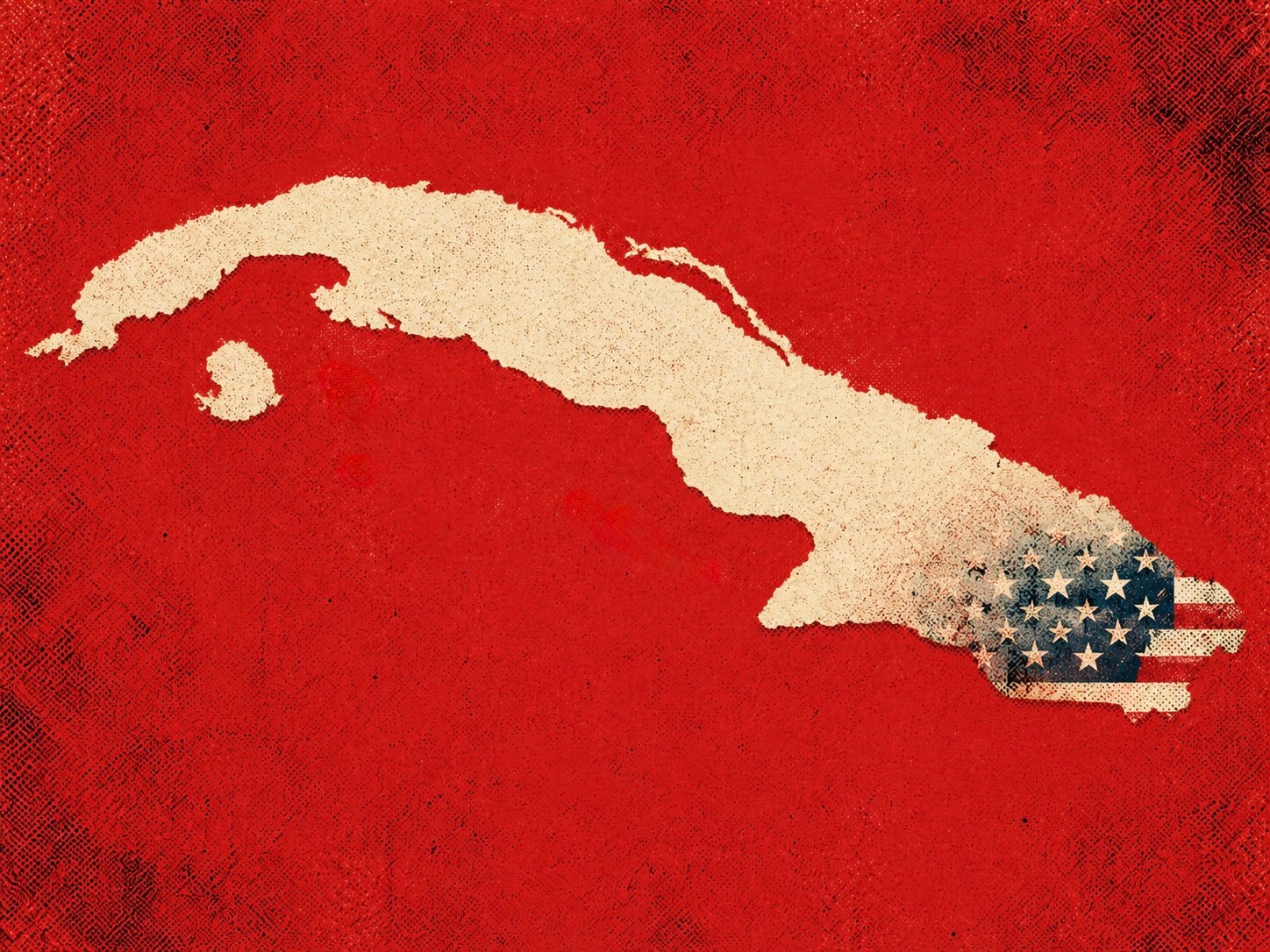
While on the one hand the United States recognizes the continuance of the ultimate sovereignty of the Republic of Cuba over the above described areas of land and water, on the other hand the Republic of Cuba consents that during the period of the occupation by the United States of said areas under the terms of this agreement the United States shall exercise complete jurisdiction and control over and within said areas with the right to acquire (under conditions to be hereafter agreed upon by the two Governments) for the public purposes of the United States any land or other property therein by purchase or by exercise of eminent domain with full compensation to the owners thereof.
-Agreement Between the United States and Cuba for the Lease of Lands for Coaling and Naval stations, February 23, 1903
Several years ago, my colleague Robert Orsi and I organized a campus reading of Guantánamo Diary, Mohamedou Ould Slahi’s autobiographical account of his fourteen-year imprisonment by the U.S. military at Guantánamo Bay. Community members signed up for fifteen-minute time slots. The Defense Department had heavily redacted the only version of the book that was available at the time, and censored lines appeared with a thick black line through them. When readers encountered redacted lines, they would ring a tabletop service bell, once for each line censored. The bell rang at regular intervals, and at times, continued repeatedly, denoting redacted paragraphs or pages. We started at 8:00 a.m. and it took nine hours to get through the book. A handful of people came in and out, listening quietly, scattered around the room in small groups. Some were visibly upset; a few were crying. People comforted one another. My turn to read aloud came over lunch, and at one point, I found myself alone, ringing the service bell and reading Slahi’s words to an empty room with high ceilings and an ornate balcony.
Slahi was released on October 17, 2016, and returned to his native Mauritania. The United States never filed charges. Was he inside or outside the United States during his detention from 2002 to 2016? Is there a U.S. border surrounding Naval Station Guantánamo Bay, or is the naval station part of Cuba? Where is Naval Station Guantánamo Bay? Where does the United States of America begin? Where does it end?
As the Cuban people’s suffering intensifies under an American-sponsored blockade, and storm clouds gather at the prospect of U.S. military operations in Cuba, the long shadow of more than a century of U.S. occupation of southeastern Cuba hovers quietly in the background, shaping political imaginations in both countries and making some options more thinkable than others.
Naval Station Guantánamo Bay (or GTMO, as the military refers to it) is a forty-five-square-mile American base located on the coast of Guantánamo Bay on the island of Cuba. GTMO is the oldest overseas American Navy base in the world and the only one in a country with which the United States does not maintain diplomatic relations. In 2022, the navy unveiled a $3 million modern postal facility to serve a community that has sent and received mail out of a converted horse stable since 1952, noting that “mail service is vital to this unique island community, where military transport a few times a week is the only means of travel to the United States.” So according to the navy the base is outside the United States. But is it?
With its rugged terrain and “dry, sun-blasted hills, where cactus and scrub clung to outcroppings of barren rock,” historian Paul Kramer explains, Spanish conquistadores left this corner of the Caribbean largely alone for centuries. Guantánamo sat suspended in the colonial margins, a “no state’s domain, a haven for pirates and slaves escaping both Cuba and Haiti, only a hundred miles across the Windward Passage at its nearest point. For them, Guantánamo had meant something like freedom.”
In the summer of 1898, U.S. warships sailed into Guantánamo Bay under the command of Bowman H. McCalla to fight alongside Cuban rebels against the Spanish fleet in a nine-day battle of the Spanish-American War, which ended with the signing of the Treaty of Paris in December 1898. Although Spain lost what remained of its overseas empire and the United States inherited most of Spain’s possessions, Congress had no intention of relinquishing control of Cuban affairs. When the Cuban Constitutional Convention began deliberations in July 1900, Congress notified the Cubans that the United States intended to attach an amendment to the Cuban Constitution. In 1901, U.S. secretary of war Elihu Root drafted a set of articles as guidelines for future United States–Cuba relations that became known as the Platt Amendment, after its sponsor, Senator Orville Platt of Connecticut. The Cubans, reluctantly and in the face of strong protest, included the Platt Amendment in the constitution. Cuba became a virtual U.S. protectorate. In 1903, the Platt Amendment was incorporated into a permanent treaty between the two countries that, according to the National Archives, “permitted extensive U.S. involvement in Cuban international and domestic affairs for the enforcement of Cuban independence.” Two articles from the treaty stand out:
III. That the government of Cuba consents that the United States may exercise the right to intervene for the preservation of Cuban independence, the maintenance of a government adequate for the protection of life, property, and individual liberty, and for discharging the obligations with respect to Cuba imposed by the treaty of Paris on the United States, now to be assumed and undertaken by the government of Cuba.
VII. That to enable the United States to maintain the independence of Cuba, and to protect the people thereof, as well as for its own defense, the government of Cuba will sell or lease to the United States lands necessary for coaling or naval stations at certain specified points to be agreed upon with the President of the United States.
The United States conditioned Cuban independence on constitutional provisions that would allow the U.S. Navy to occupy the area “for the time required.” The Cubans themselves “opposed the Platt Amendment in speech, pamphlet, and mass protest; Juan Gualberto Gómez, a delegate and a former general, charged that it would transform Cubans into a ‘vassal people.’” Nevertheless, under pressure, a divided convention adopted it.
Article VII of the Platt Amendment authorized the United States to lease or buy lands for naval bases and coaling stations in Cuba. Rent on the U.S. lease of Guantánamo as a coaling station and naval base was set at $2,000 per year beginning in 1903, paid in gold. In 1934, Cuba extended the lease and doubled the rent, with payment set at $4,085 to match the value in gold in dollars, an amount that remains unchanged to this day. The Platt Amendment was used repeatedly to legitimize U.S. interventions in Cuban affairs in 1906, 1912, 1917, and 1920. By 1934, however, widespread public criticism led to its repeal as part of Franklin D. Roosevelt’s Good Neighbor policy. But the United States retained its lease on Guantánamo Bay and continues to pay rent to Cuba via the Swiss embassy. After 1959, Fidel Castro refused to cash the checks.
And yet, under the terms of the lease, the United States retained complete jurisdiction and control over the southern portion of the bay, even as Cuba retained ultimate sovereignty. The only way to end this arrangement would be through U.S. withdrawal or bilateral agreement; the Cubans are not permitted to withdraw unilaterally.
The base has proven useful to the U.S. military. The United States launched invasions and occupations of Haiti in 1915 and the Dominican Republic in 1916 from Guantánamo. In World War II, the base became a major U.S. strategic asset, and by the mid-1940s Guantánamo was the second-busiest port in the Western Hemisphere, after New York, and was used by the navy to repel Nazi U-boats. According to the navy’s official history, “the base’s activities have at times included fleet training, ship repair, refueling and resupply, migrant operations, regional humanitarian relief and disaster assistance, search and rescue support, and detention operations. Today it remains the forward, ready, and irreplaceable US sea power platform in the Caribbean, giving decision makers unique options across the range of military and interagency operations.”
Although the United States does not claim sovereignty over Guantánamo, it does maintain “complete jurisdiction and total control” over the base. What does that mean? Where is the U.S.-Cuban border?
It is difficult to say. Kramer, the historian, describes the boundaries of the base as “indefinite.” Since 1950 the Cubans have been adamantly opposed to the U.S. presence at Guantánamo. Wary of infiltrators, in 1958 the navy put up a perimeter fence enclosing the base that still stands today. By late 1960, as relations deteriorated, a minefield containing over fifty thousand mines and spread over seven hundred acres divided the two parts of the island; at the time, it was the largest in the world. Following the 1961 Bay of Pigs debacle—a failed military attack organized by Cuban exiles working with the CIA to oust Fidel Castro—the Cubans added another barrier of uncrossable Maya cacti known as the “Cactus Curtain.” In 1964, Cuban foreign minister Raúl Roa shut off water and electricity to the base after the U.S. Coast Guard intercepted four Cuban fishing boats in American waters in the Florida Keys and imprisoned the thirty-six crewmen in a Florida jail. The water supply was never restored, and GTMO has had its own supply ever since. Land mines, concertina wire, and thickets of cacti divide the base and the rest of the island. There is no access to the base from within Cuba.
And yet, as of 2021, nineteen elderly Cubans were living on the base. Known as special category residents (SCRs), they are considered U.S. citizens. In 2021, CNN profiled retired clerk Noel West, then eighty-nine. West began working on the base in 1955 ordering fuel for planes and vehicles, commuting daily to his home in the Cuban town of Guaro. An avid baseball fan and umpire, in February 1964 he chose to stay late for a game and spent the night at the Cuban barracks on the base. The next day, his next-door neighbor from Guaro called to warn him that Cuban soldiers had been searching for him. He had mentioned to a friend that he was not a fan of the Castro regime. After fifty-five years of service, West stayed on the base after retiring in 2011 and never returned to Cuba.
Beginning in 1991, and for the next decade, GTMO served as a detention camp and processing center for Haitian refugees fleeing the aftermath of the 1991 coup against Jean-Bertrand Aristide. By July 1991, nearly 37,000 people were confined in tent cities surrounded by barbed wire. The U.S. authorities determined that 26,000 of these refugees had failed to qualify for political asylum (they were not “screened in”). Another 267 received asylum but were denied entry under a 1987 law excluding immigrants who were HIV positive that was in effect until 2010. At GTMO, the Haitians testing HIV positive who had been “screened in” were held in a separate detention area, Camp Bulkeley, where, as Kramer describes, detainees burned tents, hurled rocks at their captors, and engaged in a hunger strike to protest their mistreatment.
In 1993, a team of students and professors from Yale Law School’s Lowenstein International Human Rights Clinic filed suit on behalf of the detainees on the grounds that they should enjoy constitutional protections because the base is legally under the “complete jurisdiction and control of the United States.” The government countered that the base was “a military base in a foreign country” and “not United States territory.” Detainees being held at the base, the government argued, were “outside the United States and therefore they have no judicially cognizable rights in United States courts.” Judge Sterling Johnson Jr. responded: “You’re saying, if I hear you correctly, that assuming that they [government officials] are arbitrary and capricious and even cruel, that the courts would have no jurisdiction because the conduct did not occur on U.S. soil? That’s what you’re saying?” The government concurred.
The government lost the case, shut down the camp, and transferred the remaining detainees to the United States. Judge Johnson ruled that due process guarantees under the Constitution did extend to the base, including the right to a lawyer, to proper medical care, and to not be held indefinitely without charge. Aside from those protections, however, and according to Kramer, Johnson also told an INS attorney that the state possessed unchecked authority “to take, kidnap, or abscond, whatever you want to call it, take a group and put them into a compound, whether you call it a humanitarian camp or a prison, keep them there indefinitely while there has been no charge leveled against them and there is no light at the end of the tunnel.”
Johnson’s ruling granting even limited rights to the detainees made the Clinton administration uneasy. According to Kramer, “The Clinton Justice Department…pursued a deal with the Haitians’ legal team: the Administration would comply with Johnson’s orders and drop an appeal; in return, Johnson’s decision would be vacated from the record. The advocates agreed, fearing that an appeal would prolong their clients’ detention and might, ultimately, succeed. According to one official, the Clinton Administration wanted to preserve ‘maximum flexibility.’”
The camps were back up a year later, and by 1994, they were sheltering 16,800 Haitians and 22,000 Cubans in tent cities on the runway. When the Cuban American Bar Association, Cuban refugee associations, and the Haitian Refugee Center sued on behalf of the refugees, they were initially granted injunctive relief by the U.S. District Court for the Southern District of Florida. On appeal, the Eleventh Circuit Court of Appeals overturned that decision and, using another nickname for the base, “firmly situated Gitmo outside the United States and constitutional limits on state power.” The appeals court rejected the argument that leased military bases abroad “which continue under the sovereignty of foreign nations” were functionally equivalent to land borders or ports of entry, noting that laws mandating asylum hearings “bind the government only when the refugees are at or within the borders of the United States.” As Kramer concluded, “apparently, Gitmo was not at or within these borders.” The Cubans were released into the United States the next year, and the Haitians involuntarily returned to Haiti.
In 2002, GTMO opened its doors to its latest ignominious chapter as a U.S. prison camp for unlawful combatants who, according to then secretary of defense Donald Rumsfeld, “do not have any rights under the Geneva Conventions.” In December 2001, Justice Department deputy assistant attorney general John Yoo prepared the legal ground for indefinite detentions at GTMO with a memo to Pentagon general counsel William Haynes by making the case that Guantánamo is “foreign territory, not subject to U.S. sovereignty,” as part of an effort to make it less likely that U.S. courts would grant GTMO detainees habeas corpus rights. Yoo contrasted Guantánamo with the Philippines cases arising out of World War II, describing the latter as an “insular possession” until 1946 “and not a mere U.S. leasehold interest.”
On January 11, 2002, the first twenty captives arrived, and since then a total of 779 men have been detained at the base. The youngest was thirteen years old and the oldest was eighty-nine. Twenty-one were children. 86 percent of detainees were reportedly turned over to Coalition Forces in response to a bounty offer. As of January 2026, fifteen detainees remained imprisoned at the base.
Darryl Li describes GTMO as “one node in a global network of carceral circulation,” explaining that although new transfers had slowed by 2003 (and stopped entirely by 2008), “it was the older pattern of arms-length detention through local clients that has endured and continued to sustain GWOT [global war on terror].” When it comes to U.S. carceral practices in sovereign gray zones, Li suggests that GTMO stands in for a vast array of long-standing U.S. practices involving the use of client states and partners to carry out the U.S. government’s dirty work. Sites run in and by the United Arab Emirates and by Kurds in eastern Syria “enabled the US to warehouse, interrogate, and dispose of thousands of more people with far greater flexibility and far less scrutiny than at GTMO.”
Borders around black sites are purposefully ambiguous. Where America begins and ends is intentionally fuzzy. Detainees are held in limbo. The OED defines limbo as referring not only to prison or confinement but to “any unfavourable place or condition, likened to Limbo; esp. a condition of neglect or oblivion to which persons or things are consigned when regarded as outworn, useless, or absurd.”
Some have pushed back. One legal strategy is to actively draw the U.S. border around detainees to try to encompass them within U.S. constitutional protections. An example is the case of Lakdhar Boumediene, an Algerian-born citizen of Bosnia and Herzegovina who was the subject of a 2008 Supreme Court decision, Boumediene v. Bush, ruling that detainees were not barred from seeking habeas corpus or invoking the suspension clause merely because they had been designated as enemy combatants or held at Guantánamo. Boumediene’s detention began in 2002, when he and five other Algerians were seized by Bosnian police because U.S. intelligence officers suspected their involvement in a plot to attack the U.S. embassy in Bosnia. The United States classified the men as enemy combatants in the war on terror and imprisoned them at GTMO. Boumediene filed a petition for a writ of habeas corpus (lit: “that you have a body,” a form of legal recourse against unlawful detention), alleging violations of the Constitution’s due process clause, various statutes and treaties, the common law, and international law. The district court granted the government’s motion to have his claims dismissed on the ground that Boumediene, as an alien detained at an overseas military base, had no right to a habeas petition. The U.S. Court of Appeals for the DC Circuit affirmed the dismissal. But the Supreme Court reversed in Rasul v. Bush, holding that the habeas statute extends to noncitizen detainees at Guantánamo. Foreign nationals held at GTMO could petition federal courts for writs of habeas corpus to review the legality of their detention.
Two years later, Congress passed the Military Commissions Act of 2006 (MCA), which eliminated federal courts’ jurisdiction to hear habeas applications from detainees who had been designated as enemy combatants according to procedures established in the Detainee Treatment Act of 2005. When Boumediene’s case was appealed to the DC Circuit for the second time, he and the other detainees argued that the MCA did not apply to their petitions and that even if it did, it was unconstitutional under the suspension clause. (The latter reads: “The Privilege of the Writ of Habeas Corpus shall not be suspended, unless when in Cases of Rebellion or Invasion the public Safety may require it.”) The DC Circuit ruled in favor of the government on both points, citing language in the MCA applying the law to “all cases, without exception” that pertain to aspects of detention. One of the purposes of the MCA, according to this court’s interpretation, was to overrule the Supreme Court’s opinion in Hamdan v. Rumsfeld, which had allowed petitions like Boumediene’s to go forward. The circuit court thus held that the suspension clause only protects the writ of habeas corpus as it existed in 1789 and that the writ would not have been understood in 1789 to apply to an overseas military base leased from a foreign government. The court held further that constitutional rights do not apply to aliens outside of the United States and that the leased military base in Cuba does not qualify as inside the geographic borders of the United States.
The Supreme Court then ruled that if the 2006 MCA were considered valid, its legislative history would require that the detainees’ cases be dismissed. However, they also found that because the procedures laid out in the Detainee Treatment Act are not adequate substitutes for the habeas writ, the MCA operates as an unconstitutional suspension of that writ. The detainees therefore were not barred from seeking habeas or from invoking the suspension clause merely because they had been designated as enemy combatants or were being held at Guantánamo.
With the court’s reversal of the DC Circuit’s ruling, the border began to come into focus, a faint dotted line provisionally encircling the detainees at Guantánamo and, perhaps, other black sites.
The “abject,” notes J. Kameron Carter, “is neither friend (subject) nor enemy (object). The abject exists in the zone between life (full citizenship) and death (the enemy as one who must be killed).” The category of abject, or homo sacer (sacred man, in Roman law), includes detainees at Guantánamo and others in border limbo. It includes Jews in mid-twentieth-century Europe and the figure of the slave, “modernity’s abject par excellence,” all of whom have been forced outside the bounds of humanity. It includes Palestinians in Gaza. Today it includes the Cuban people.
Borders are brokers of abjection. They can be hard to see because the abject exists in a border zone between life and death. Neither in nor out. Neither domestic nor foreign. Neither wholly part of the body nor wholly apart from it. She sits with other liminal subjects in the margins of global order.
In Downes v. Bidwell, one of the Insular Cases, the majority found that “Porto Rico belongs to the United States, but nevertheless, and notwithstanding the act of Congress, is not a part of the United States subject to the provisions of the Constitution in respect of the levy of taxes, duties, imposts, and excises.” Dissenting Justice Melville Weston Fuller interpreted this to mean that, “if an organized and settled province of another sovereignty is acquired by the United States,” Congress would retain the power “to keep it, like a disembodied shade.”
Puerto Rico, the U.S. Virgin Islands, Guam, the Northern Mariana Islands, American Samoa, the Federated States of Micronesia, the Republic of the Marshall Islands, and the Republic of Palau are liminal jurisdictions that are kept by the United States “like a disembodied shade, in an intermediate state of ambiguous existence for an indefinite period.” They live in the shadows of sovereignty, belonging to the United States but not part of it.
Speaking at the Future Investment Initiative summit in Miami in March of this year, Trump boasted, “We have been very, very successful. You know, when I went into Venezuela … I built this great military, I said, you’ll never have to use it, but sometimes you have to use it,” adding, “and Cuba’s next, by the way.” In threatening to “stop by Cuba after we’re finished” with Iran, Trump reaffirms Cuba’s inferior position as a subject of the long-standing American prerogative to “exercise complete jurisdiction and control over and within said areas.” Neither in nor out, neither domestic nor foreign. Neither wholly part of the body nor wholly apart from it. In the logic of American empire, Cuba subsists indefinitely in the shadows, and America never ends.
This essay is adapted and reprinted with permission from Heaven Has a Wall: Religion, Borders, and the Global United States by Elizabeth Shakman Hurd, published by the University of Chicago Press. © 2025 by The University of Chicago. All rights reserved.
 | A guest post by
|
I would be concerned about what the Supreme Court would do today with a challenge from a detainee at Guantanamo Bay, given that one of the driving forces behind the War On Terrorism opinions is no longer on the Court, leaving justice with any national security experience or armed forces experience, and the attitude of the current Court toward executive powers.