


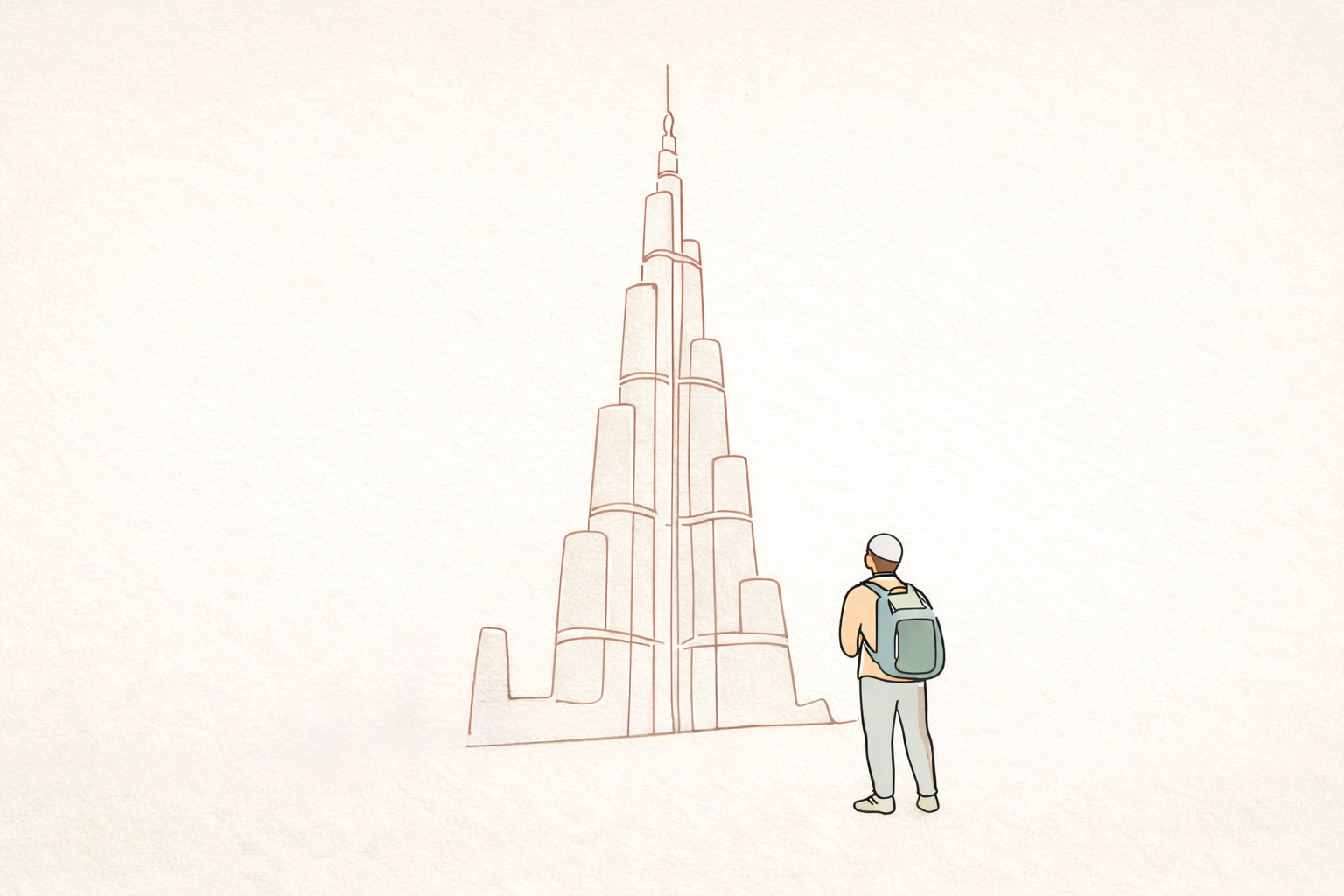
When I moved to the United Kingdom in 2013, I thought Islam had six pillars: the declaration of faith, the five daily prayers, the fasting of Ramadan, the giving of alms, and the two pilgrimages: one to Makkah, and the other, naturally, to Dubai.
It was about five years after my conversion to Islam, and almost everyone I knew or followed on social media seemed committed to visiting Dubai at least once a year. Had Hajj become so expensive that Dubai replaced Makkah? The rituals were rather similar: circumambulating the Dubai Mall seven times, camping for a night in the desert, and throwing money (rather than pebbles in Mina) at consumer items ranging from designer clothes to A5 wagyu steaks.
Now, more than a decade later, the craze for Dubai has not subsided a whit (if the global popularity of Dubai chocolate is any indicator). As a sociologist researching Muslim-related issues in Euro-America, I have often wondered: what attracts so many Muslims—especially in the West—to Dubai?
Homeless Dreams
Dubai is not what it used to be. For anyone serious about corporate money today, Riyadh is the place to go. Dubai’s wannabe entrepreneurs, high-flying workers, and social media celebrities are now barely making ends meet—or trying to hold in place the cracked veneer of a six-star lifestyle. Everything is rented or on loan. From housing, to cars, to designer handbags, life in Dubai is simply becoming less and less affordable.1 And no, Dubai is not free of crime (unless you think white-collar crime doesn’t count).2 Only Dubai’s reputation as a tax haven still holds, alongside its infamy as the largest hub for sex work (and scandals) in the Middle East. Despite these realities, many people from around the world regularly vacation in Dubai, and some even contemplate permanently resettling there by making “hijra.”
Hijra, in its original sense, refers to the migration to Medina of the Prophet Muhammad and his companions from the oppression they faced in Makkah. Their aim was to freely build a true Muslim society. Today, any escape from an environment perceived as hostile to Muslims (typically “the West”) tends, haphazardly, to be described as a “hijra.” Yet much disagreement surrounds it as both a practice and an idea. While many British and American Muslims dream of making hijra to Dubai for its comforts, I have known people who made hijra to Tunisia in order to build a village in the desert from scratch, and others who made hijra to Jordan to set up a permaculture community. I have also met many French Muslims who made hijra within Europe itself—to the British city of Birmingham, for example. And while Dubai is a coveted hijra destination for many, the reality is that plenty of others who live and work there today contemplate migrating to “greener pastures” in Malaysia, Türkiye, Bosnia, or elsewhere across Asia and Europe. Everyone is looking for something different under the banner of “hijra.”
Romanticization plays some role here. In the twenty-first century, Islamic revivalist movements and popular culture have sold the Muslim diaspora the dream of a lost, romantic past: the times of the Revelation, the Golden Age of Islamic civilization under the Abbasids, the imperial strength of the Ottomans, and so on. These are depicted as times when Muslims were strong, affluent, and in power. The Islamicate of the past is imagined as untouched by the modern corruptions of the “West.” Television series like Omar and Diriliş: Ertuğrul, charismatic athletic figures like MMA champion Khabib Nurmagomedov, and scenes like the Speakers’ Corner “dawah” debates on social media are all highly popular because they piggyback on images of power that redress a collective loss of self-esteem. “We, Muslims, were once victorious,” so the mantra goes.
Curiously, this longing for the “golden age” of Islam often trades diasporic Asian, African, and Levantine cultures for the Arabian Peninsula’s own local, khaliji customs. Khaliji culture is perceived as “purer” because of its proximity to the birthplace of the Prophet Muhammad and the holy sites of Makkah and Madinah. This image of purity is also the fruit of a concerted campaign by Saudi Arabia which, since the Cold War and under American influence, has sought to spread a particular form of Saudi-supremacist Islam to Euro-America.3 As a result, South Asian men in London can be heard calling themselves akhi instead of bhai, and can be seen in white thobes and head caps (remnants of Zoroastrianism) instead of shalwar kameez, djellabas, or bazin.4 These were among the ways that British Islamicate cultures sought to relocate themselves in an Arab and Middle Eastern imaginary, by asking “how can we live like the first Muslims did?” For many, Dubai emerges as an answer because it has both the aesthetics of “Islamic traditionalism” and the power of a regional hegemon.
Yet the search for a more empowered and authentic “Muslim” identity (conflated with “Arab” identity) by a homeless diaspora is not the only driver of hijra-cum-Dubai mania. It might not even be an especially important factor. The fact is that Muslims don’t migrate to Dubai in search of an alternative lifestyle, but to find an even deeper sense of comfort. In Dubai, your business loan can be as “halal” as your Big Mac. For many, that is an attractive promise.
Halalified Comfort
Anyone who visits downtown Dubai would scratch their head trying to find what differentiates it from any other large American urban center like Los Angeles or New York. The city itself was designed by British urban planner John Harris and modeled after large American metropolises with a focus on leisure and entertainment similar to Las Vegas.5 In the present day, one can find in Dubai all the comforts of any large American city: efficient public transit, luxury resorts, sports facilities, suburban houses in gated communities with swimming pools, and perhaps most importantly, all the major banks and fast-food chains of the world stamped with a big “halal” sign. The neoliberal structure of the Euro-American economy is perfectly reproduced in Dubai, and its rampant consumerism, unchecked capitalism, and exploitative labor practices all feel very familiar. These familiarities often play a greater role in attracting “Muslim migrants” than anything about Islam itself.
From mortgages and food to scam crypto projects, Dubai is a place where the uncritical copy-paste of Westernese life is custom-fit for a Muslim audience. There you can find, for example, Global Village, a giant theme park which aspires to be nothing more than a sort of Muslamic Disneyland. You can also purchase ZamZam water in $30 glass bottles, grab a nice glass of “halal” wine or champagne, visit the city’s all-new “halal” casinos, and purchase designer “Muslimwear” like the Nike hijab. These “halal” offerings not only commercialize Islam into a brand devoid of values and meaning but destroy the socio-spiritual and ethical fabric of a community. Muslims are not seen as two billion believers but two billion consumers. Labelling things “halal” without changing any of their questionable ethics has a name: “Islam by technicalities.” Anything can be made “halal” for the right amount of money. Going to the Las Vegas of the Middle East permits a life without hesitations or second guesses. You’ll never need to examine any food labels for traces of pork gelatin ever again. The trade-off is silent compliance: never question how everything around you is built and produced. Just consume and enjoy.
The commercialization of Islam represents an effort to depoliticize Muslims and disconnect them from their moral frameworks.6 What better way to erase the meaning of the hijab, for example, than to turn it into a fashion accessory? When people tell me about their role models, saying they want to see a Muslim Elon Musk, a Muslim Mark Zuckerberg, or a Muslim Rupert Murdoch, I always wonder why nobody thinks instead of a British Malcolm X, an American al-Ghazali, or a European Rabia al-Adawiyya. Why is it always white, rich, secular males who often have a disdain for Muslims that we take as role models? That so many Muslims cheered Hamza Yusuf’s engagement with Jordan Peterson, or the conversion to Islam of redpiller Andrew Tate, suggests that, despite seeing the “West” as an antagonist, Muslims still crave its validation. This is understandable for people who, for generations, have been deprived of financial stability, media representation, and political visibility.
This is part of the reason Dubai is so appealing: it is seen as the bastion of an imagined cultural and economic revenge on life. And in a twisted way, it is. But if retail therapy is not the answer, then what is?
Between Duty and Divestment
Perhaps a real hijra requires a move away from structures of oppression, not the “West.” The Palestinian-American professor Hatem Bazian says Muslims should be guided by a shared ethos which “must be about severing our relationship to products produced by corporation[s] in sweatshops [in] far distant lands, [and which use] the poverty of people to maximize profit while treating them as modern wage slaves.” The writer Ali Harfouch similarly urges us to “revolt against the Homo Economicus [the human that earns, produces, and consumes]” and to stop worshipping the “god of Capital.”
Bazian and Harfouch are right. We need to boycott and divest from systems of oppression around us, not just the amorphous idea of “the West.” By convincing ourselves that the problem is “the West” and not, say, rampant neoliberalism, we delude ourselves into thinking an “escape” to Dubai fulfills an ethical imperative. Ironically, Dubai is in fact a Western city par excellence and one of the global centers of neoliberal life.
Still, absolute divestment, both materially and ideologically, is no easy task. And, perhaps more importantly, it is not clear that “hijra” is the means by which to achieve it. If I were to “make hijra,” what happens to those I leave behind who cannot afford the luxury of packing up and leaving? Don’t I have a duty and responsibility toward them, given the privileges, resources, and knowledge I possess? Since I have learned how to navigate this society—my own home and community—who am I really benefitting by suddenly relocating to another, foreign place?
Beyond divestment, however, is the question of flourishing. Who will build the alternatives to the systems that we boycott? In a way, I believe these alternatives already exist, and we must actively nurture them. They are “too grassroots” to feature in mainstream media, not flashy enough to be “Instagrammable,” and they often fly under the radar of public attention. Whether it is through community hubs, artists collectives, alternative media platforms, healthcare initiatives, or even ethical fintech start-ups, people are constantly strategizing and organizing in response to the Dubaization of our lives. They are living out an alternative in the margins.
Perhaps some will argue there is a third path and that building alternatives requires resources which many marginalized communities cannot access. Accordingly, temporarily moving to Dubai, making a lot of tax-free money through corporate work, and then returning home can seem to make sense. Can’t Dubai, and the Gulf states more broadly, be a means to a righteous end? What if we took advantage of Dubai as a money pump with the aim of redistributing wealth within our own communities? While the idea is tempting, the fact remains that, in one way or another, we are contributing to an economy heavily reliant on exploitation. Isn’t every economic migrant from the West just fodder for Dubai to accelerate its growth?
In the videogame Deus Ex: Mankind Divided, the first mission is set in 2029 Dubai—or, more exactly, the ruins of Dubai. In a near future where the Emirate overly relies on unstable technology and questionable labor practices, a technological catastrophe leads workers to commit acts of violence, destroying properties and forcing people to flee. As a result, you—the player—are left roaming in a half-built luxury resort, admiring the skyline of the abandoned city. The deeper we wade into the age of agentic AI and technological acceleration, the less Deus Ex seems like fiction. Cataclysm or not, it is public knowledge that the Emirates’ natural reserves are limited. It is not a matter of if, but when, the oil reserves and money dry out. The cracks are already showing.
What will we do, then, when Dubai falls? Where will we go? We owe it to ourselves to start imagining a future without Dubai and all it represents while also thinking seriously and honestly about the limitations of “hijra” as we seek to build a better world.
The Mercer global cost of living city ranking names Dubai 15th most expensive city to live in the world, up 27 positions from 2021: https://www.mercer.com/insights/total-rewards/talent-mobility-insights/cost-of-living/.
The UAE is ranked 42nd safest out of 193 countries, mainly due to its high rate of human trafficking and financial crimes (Source: “Global Organized Crime Index 2025,” Global Initiative Against Transnational Organized Crime, https://ocindex.net/assets/downloads/2025/english/ocindex_profile_united_arab_emirates_2025.pdf). The UAE is also ranked second most targeted country in the Middle East for cyberattacks (Source: “UAE cybercrime statistics 2025: Key data and trends,” CPX, September 19, 2025. https://www.cpx.net/insights/blogs/uae-cybercrime-statistics/). Dubai is the largest hub for illegal gold trading and one of the largest for counterfeit goods and heroin trafficking (Source: Peter Appleby and Monserrat Peters, “Is the UAE’s Role as a Safe Haven for Traffickers Waning?” InsightCrime, June 10, 2025, https://insightcrime.org/news/is-the-uaes-role-as-a-safe-haven-for-traffickers-waning/).
Khaled Abou El Fadl, The Great Theft: Wrestling Islam from the Extremists (Harper, 2005).
William Barylo, British Muslims in the Neoliberal Empire: Resisting, Healing, and Flourishing in the Metacolonial Era (Oxford University Press, 2025).
Heiko Schmid, “Economy of Fascination: Dubai and Las Vegas as Examples of Themed Urban Landscapes,” Erdkunde 60, no. 4 (2006): 346–361, https://doi.org/10.3112/erdkunde.2006.04.05; Heiko Schmid, Economy of Fascination: Dubai and Las Vegas as Themed Urban Landscapes(Gebrüder Borntraeger, 2009); Ana Virtudes, Arwa Abbara, and João Sá, “Dubai: A Pioneer Smart City in the Arabian Territory,” IOP Conference Series: Materials Science and Engineering 245, no. 052071 (2017): 1–10, https://doi.org/10.1088/1757-899X/245/5/052071; Khaled Alawadi, “Rethinking Dubai’s urbanism: Generating sustainable form-based urban design strategies for an integrated neighborhood,” Cities 60 (2017): 353–366, https://doi.org/10.1016/j.cities.2016.10.012.
Barylo, British Muslims in the Neoliberal Empire.

Excellent essay, truly eye-opening. Thank you for this.
Amazing piece, thank you for writing and I hope more and more people see through the facade.